|
SINKING THE SHAFT
After several earlier
attempts at sinking the shaft had failed
Cefn Coed Colliery was successfully opened
by the Amalgamated Anthracite Company in
1930. It took 4 years to reach the coal
because of a very thick layer of blue
pennant sandstone. By the time coal was
first raised in 1930 Cefn Coed was the
deepest anthracite mine in the world -
almost half a mile down (687 metres).
|
|
 The
Sinking of Cefn Coed
The
Sinking of Cefn Coed
|
|
|
| |
|
|
|
|
COAL PRODUCTION BEGINS
|
But it
would be a further 3 years before the colliery was
fully operational. After the shafts were sunk there
was a myriad of other work to be carried out before
the mine would be fully functional. Underground
roadways would have to be constructed, transport
facilities like the winding engine to winch drams to
pit bottom, compresses air line for powering tools.
Pumps were required to
pump water out of the mine and miles of pipe
lines to bring the water to the surface.
Stalls had to be opened so colliers could
cut coal, stables created at the pit bottom
for the pit ponies. Because of this when the
colliery began production output could not
keep pace with the demand of anthracite coal
from Canada – it only cost seven shillings
per ton to ship coal to Montreal in Canada
but 11 shillings and ninepence to London! |
|

Group of
Cefn Coed Miners, 1930

Cefn Coed
Colliery, c.1930
|
|
|
| |
|
|
|
|
ANTHRACITE COAL FROM CEFN COED
Five
seams were worked at various times the deepest being
the ‘peacock’ seam, so called because the coal had a
beautiful blue/green sheen like a peacock’s
feathers. The type of coal that was mined at Cefn
Coed was called anthracite, a hard coal with a high
carbon content which made it burn very efficiently.
|
An
advert by the Amalgamated Anthracite Company reads:
‘WELSH
ANTHRACITE – THE WORLD’S FINEST FUEL’
‘Don’t burn money BURN ANTHRACITE.
Anthracite is the cheapest form of
heating available. An anthracite fire
will burn continuously day and night at
a cost of less than 4d per day’ |
Anthracite coal was sold in a variety of sizes: peas
for open grates, nuts for boilers and cobbles for
stoves. Coal was used in the home and by industry
e.g..
Power stations and exported.
WORKING
CONDITIONS
Miners
had to pay for their own tools such as a pick,
shovel, mandrel, working clothes and boots. The
great depth at which the colliers worked caused
problems of intense heat and they would often
complain that by mealtime the cheese in their
sandwiches had melted like butter. The depth caused
other problems and accidents such as roof falls were
so common that the colliery soon became nicknamed
the ‘slaughterhouse’.
CEFN
COED CLOSES
|
Amalgamated Anthracite Company continued to operate
the colliery until nationalization in 1947. But
the depth of the colliery meant that eventually the
cost of keeping the roadways open underground took
their toll and by the 1960’s the colliery was
employing more men to maintain the colliery than
colliers themselves and as a result and the colliery
finally closed in 1968. Many of the men transferred
to the adjacent drift mine of Blaenant.
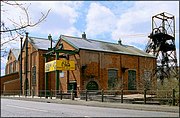
The Museum was opened
in 1986 on the site of Cefn Coed using some of the
original buildings. |
|

|
|
|
| |
|
|
|
|
|


